Dear Friends and Colleagues,
It is an honor to take part in A Century of Black History Commemoration at the Florence Douglas Center, marking one hundred years since the first Black History Week. I am especially grateful to join this gathering under the official theme selected by the Association for the Study of African American Life and History (ASALH): “Black Health and Wellness.”
The work I will share, Looking Back / Moving Forward: Black Memory, Wellness, and the Work of Refusing Erasure, is a three-section spoken poem designed specifically for communal listening. It moves across past, present, and future, asking how Black life has learned to survive history, how it has sustained itself through care and restraint, and how it now claims the authority to design what comes next.
Rather than approaching wellness as a contemporary slogan, the poem treats it as a long historical struggle—one shaped by labor, breath, vigilance, creativity, and collective endurance.
Section I — When the Fire Speaks First
Origins, Extraction, and the Cost to the Body
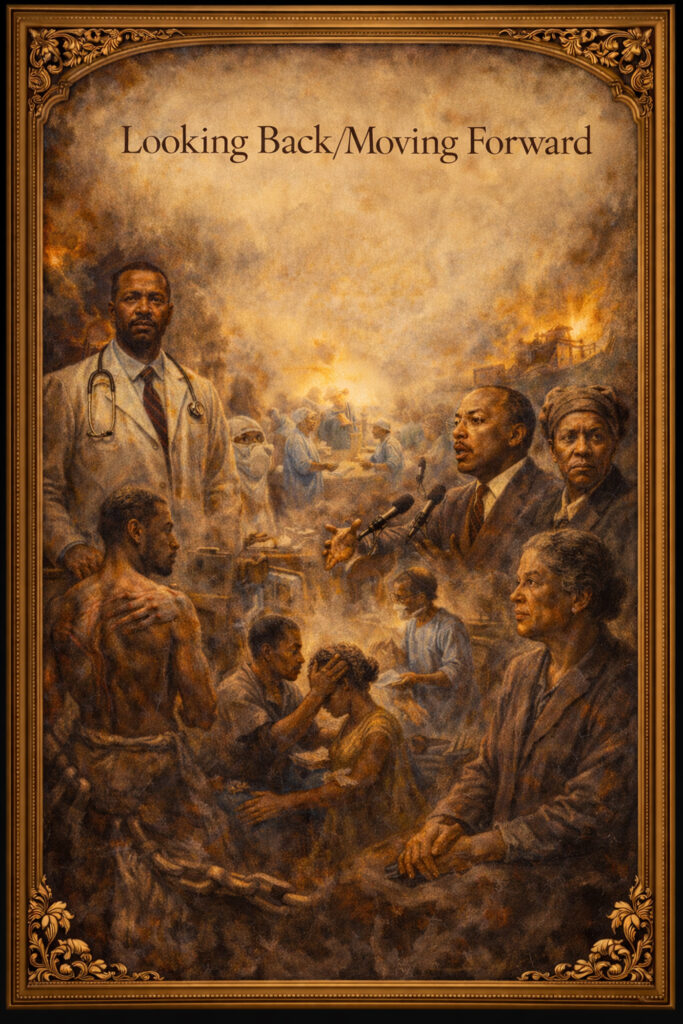
The opening section looks back to the foundations of American history, where Black bodies were treated as assets rather than lives. Using fire as a central metaphor, this section examines slavery, forced labor, medical neglect, and institutional erasure—not as distant events, but as experiences written directly into lungs, backs, joints, and nervous systems.
This portion establishes that Black health has never been abstract. It has always been negotiated under pressure, shaped by extraction, and burdened by silence. It also addresses the present-day attempts to soften, edit, or erase this history, reminding us that remembrance did not begin with official permission and cannot be ended by revision.
Section II — The Quiet We Kept
Endurance, Care, and the Discipline of Survival
The second section shifts from fire to quiet—not as submission, but as strategy. It honors the unrecorded labor of survival carried out in homes, churches, streets, and private decisions. Here, wellness appears as discipline: knowing when to move, when to remain still, when to speak, and when silence itself preserves life.
This section centers the often-invisible work of Black women, whose care, restraint, and emotional labor have held families and communities together across generations. It also reflects on different traditions of resistance—patience, refusal, moral insistence—not as contradictions, but as tensions that have sustained the bridge between survival and change.
Section III — When the Fire Returns
Wellness, Power, and the Future We Design
The final section turns forward. Fire returns not as rage alone, but as intention. This portion addresses contemporary systems—healthcare, technology, data, economics—that risk reproducing historical inequities under modern names. It insists that Black communities must be present not merely as participants in the future, but as its designers.
Here, wellness becomes infrastructure rather than reward. Care becomes policy. Healing becomes leadership. The section celebrates Black creativity—music, movement, art, organizing—not as cultural ornament, but as a long-standing technology of survival and vision. It closes by rejecting permission-based inclusion and affirming ownership of story, strategy, and tomorrow.
Together, these three sections form a single arc: from damage endured, to endurance refined, to intention claimed. The work holds fire and quiet together because both are true. Silence alone disappears. Rage alone burns out. But breath—trained, shared, and insisted upon—makes continuity possible.
I look forward to sharing this work in community, and to honoring Black history not only as memory, but as a living force shaping health, dignity, and the future we are still building together.
With respect and gratitude,
Valdez Hill